16 things this year as a teacher taught me 2025/2026
Summer has arrived and the school year of 2025/2026 has come to an end. Even though I am still teaching some courses throughout this summer, I decided to draw a line and mark the end of the school year by taking some time to reflect.
As I am currently on the train, heading to my hometown for my mom’s birthday, I decided to use the peacefulness of the golden hour to sit down and craft this blog post. You’re right – I do love writing and thinking on trains! I am always filled with ideas when staring at the moving green fields outside the window.

Once, in my stories, I described this year with one word: solid.
Solid – because of the consistent effort, safe routines and established frames that defined it.
Every single week, my schedule was filled from morning until late evening, including weekends. For this reason, it was not an easy year, but I kept showing up, one step at a time, always doing my best. Through consistent effort.
I focused on creating some safe routines including weekly affirmations, the verb of the week intro and revision games. These weekly rituals seemed to keep our courses pleasantly predictable, coherent and interconnected.
As for the established frameworks, I finally felt like I truly knew what I was doing. I have been teaching English for 5 years, I have just completed my 2nd year as a French teacher, I have been doing internships in public schools for 4 years and I finally felt more or less established both on social media and within the teaching community. I knew my teaching philosophy. I explored various tools and methodologies. Having crafted my own teaching method – especially for my Cambridge exam preparation courses – I simply enjoyed the process. Now, I am curious about what the next step might be, and I am looking for new inspiration.
Regardless of this sense of stability, this year taught me A LOT. I became more pragmatic and realistic, and I stopped glorifying any single method. I realised that everything ultimately comes down to personalisation.
A funny realisation came to me during one conversation: what one person loves about a course is exactly what another person dislikes about it. One student loves a course because it is full of pair work; another hates it for the same reason. One student enjoys deep conversations while another prefers to focus strictly on the curriculum, without becoming too personal. We cannot create a universal offer. The same shoes will never fit everyone. It’s a simple but powerful discovery.
Now, let’s move on to the 16 lessons this year as a teacher taught me:
#1 NEW CHALLENGES GIVE PERSPECTIVE
The fastest way to appreciate your progress is to become a beginner again.
Learn or teach a new language and you’ll realise that many of the things you now do effortlessly were once challenges you had to overcome.
#2 CREATE MEMORIES THAT LAST
Students grow up. Classes end. You may change your workplace.
So, seize that moment. Be present. Make it special. The memories you create can last a lifetime. Those little keychains you give them may stay on their backpacks forever. The cards you made together may become their favourite story to tell. Appreciate the time you have together.
#3 BREAKTHROUGH MOMENTS ARE LIKE AN ICEBERG
As described in Atomic Habits, progress often happens beneath the surface long before it becomes visible. Students may not see immediate results, but every small effort matters. Then one day, all the dots connect, confidence grows and they accomplish things they once thought impossible.
I AM SO PROUD!
#4 TEACHERS ARE CONNECTORS
During the Language Teachers’ Festival in Brno (greetings to Nina!), we talked about teachers being motivators, organisers, guides and connectors. For years, I overlooked the connector’s role. This year, I put my heart into helping my students feel safe around each other, creating opportunities for them to get to know one another, say kind things to each other, open up and build friendships.
#5 FEAR OF FAILURE MIGHT STOP YOU FROM TAKING ACTION
Sometimes anxiety and low self-esteem prevent students from taking action. Support them with kindness, but also hold them accountable. Encouragement builds confidence. Constructive feedback builds growth.
#6 THERE IS NO ONE RIGHT WAY TO TEACH
In some settings, I use textbooks; in others, presentations. Sometimes, I incorporate elements of language coaching. Other times, I teach in school settings. All of these approaches make sense. They all have their strengths and limitations. None should be demonised or glorified. This year, I spent a lot of time searching for the best method, only to realise there might not be one.
#7 MODEL THE PROCESS, NOT JUST THE RESULT
Students need more than instructions, and feedback isn’t enough. They need to see the thinking behind the process. Instead of telling them how to write a letter, write one together. Instead of correcting the final product, build it with them step by step.
#8 STUDENTS LOVE TESTS MORE THAN EXPECTED
Especially when the classroom atmosphere is supportive. Many of my students appreciated regular revision tests and some even asked for more. When I suggested reducing the number of tests, no one wanted to. Tests keep students motivated, encourage consistent revision and create opportunities for self-reflection and self-adjustment.
#9 PRONUNCIATION DESERVES FEEDBACK TOO
Almost all of my students told me they wanted more support with pronunciation. Feedback shouldn’t focus only on grammar and vocabulary. Students also want to know how they sound. This year, I started giving more pronunciation feedback and it’s an area of my teaching I’d like to continue developing.
#10 EVERY STUDENT SHAPES THE GROUP
Many times, one student left our group and another joined. Quiet groups became talkative. Easily distracted groups became focused. The atmosphere became more intimate, humorous or more artistic. Students’ favourite activities shifted from games to writing to projects. It was fascinating to watch how a single person could reshape the entire group.
#11 KEEP THE PLAN FLEXIBLE
At first, I didn’t plan my lessons in advance and my courses felt too chaotic. Then, I started creating detailed plans for weeks ahead but they left no room for delays or adjustments. Now, I’m trying to find the golden mean between structure and flexibility.
#12 CREATE, TAKE HOME, KEEP FOREVER
Students love project-based learning because it allows them to leave the classroom with visible proof of their time, effort, learning and growth. I’m sure it helps them remember those lessons for much longer and I DEEPLY love listening to them talk about their presentations, posters, cards and poems.
#13 THE OFFER WILL NOT ALWAYS SUIT YOUR STUDENTS
Maybe your students need to switch from group classes to individual lessons, change the course type, textbook or language level. Don’t take it personally. You can’t change the offer simply by trying harder to accommodate everyone. People choose what suits them best – and that’s great!
#14 INTERLANGUAGE MISTAKES ARE FUN
I am a bit too obsessed with multilingual mistakes that stem from my learners’ linguistic backgrounds, bilingualism and the languages they know. Yes, I do love analysing them. English affects French, Czech affects English, French affects English, there are false friends between Czech and Polish, Polish and Russian, and so on… Interlanguage is one of the most fascinating things ever!
#15 DO NOT OVERHELP
Let learners think and figure it out. Wait, even if it takes time. Scaffolding should be removed as often as possible to increase independence.
This one is a tough lesson for me because I worry about my learners feeling stressed or stuck. But that’s part of the process.
#16 SHOW WHAT DOORS CAN BE OPENED
Teaching is not only about the skill itself. It is also about sharing our story. Showing what doors these beautiful languages have helped us open. Inspiring. Hinting. Helping learners discover their own language potential.
And you? What did you learn? Which thought can you relate to?
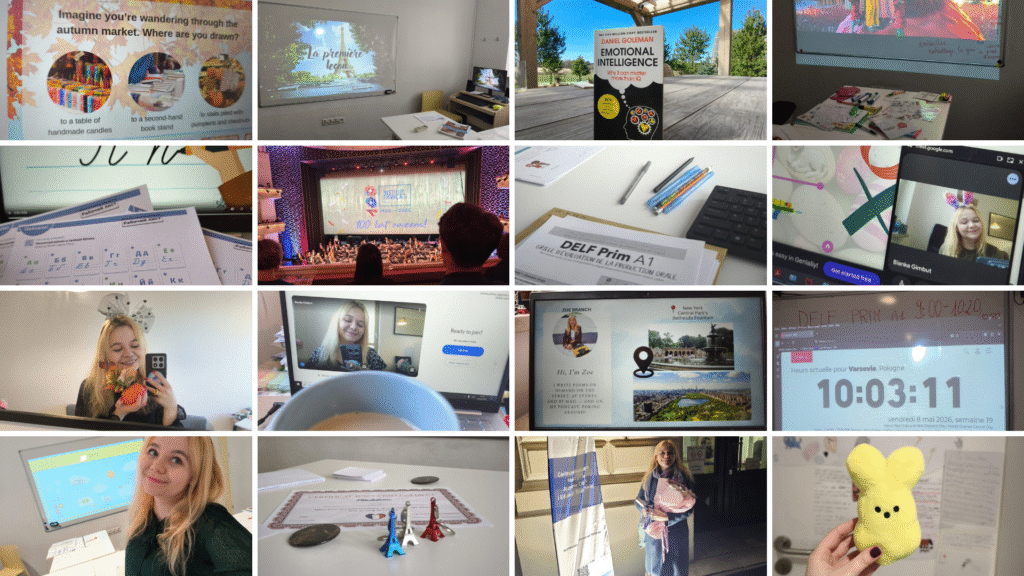
Let me end this post by sharing a collage with some pictures from this year, including:
- My university graduation
- The first online lesson in September (English)
- The first live lesson in September (French)
- Reading “Emotional Intelligence” – a book that marked my approach to teaching this year
- Christmas and Halloween lesson time
- Examining session – my first oral examining experience!
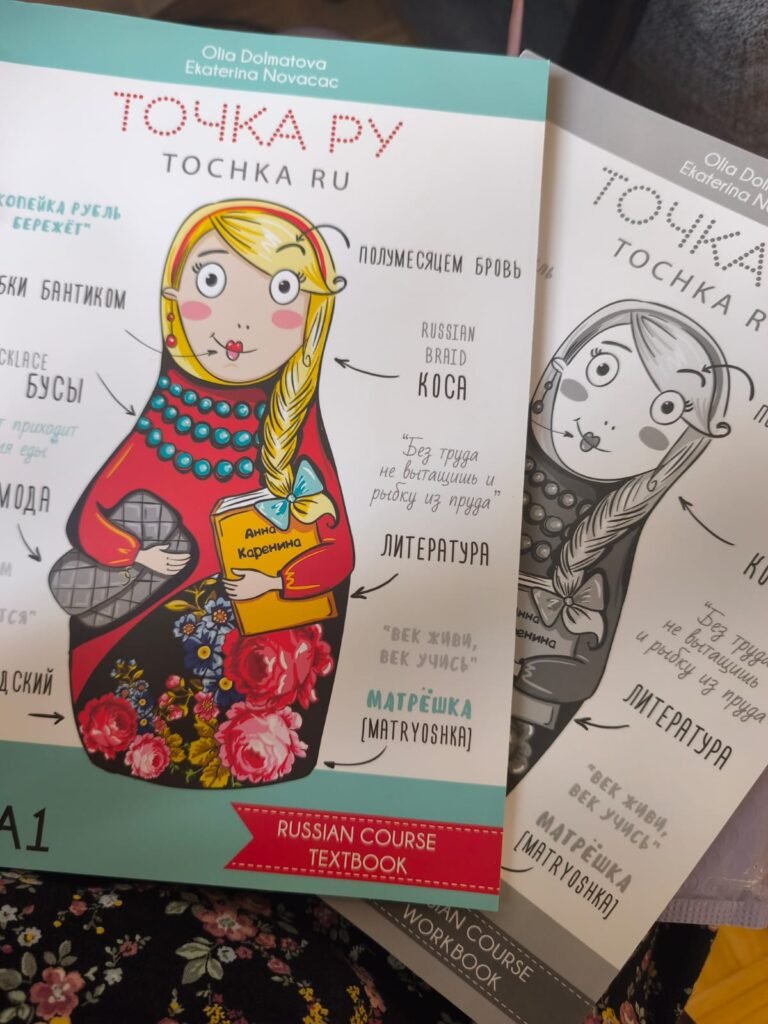
- Learning the Russian alphabet
- A cute lesson about autumn
- The 100th anniversary night of the French Institute
- Poetry lesson
- Easter headbands and fun