Why teach English through poetry?
Cause why not?
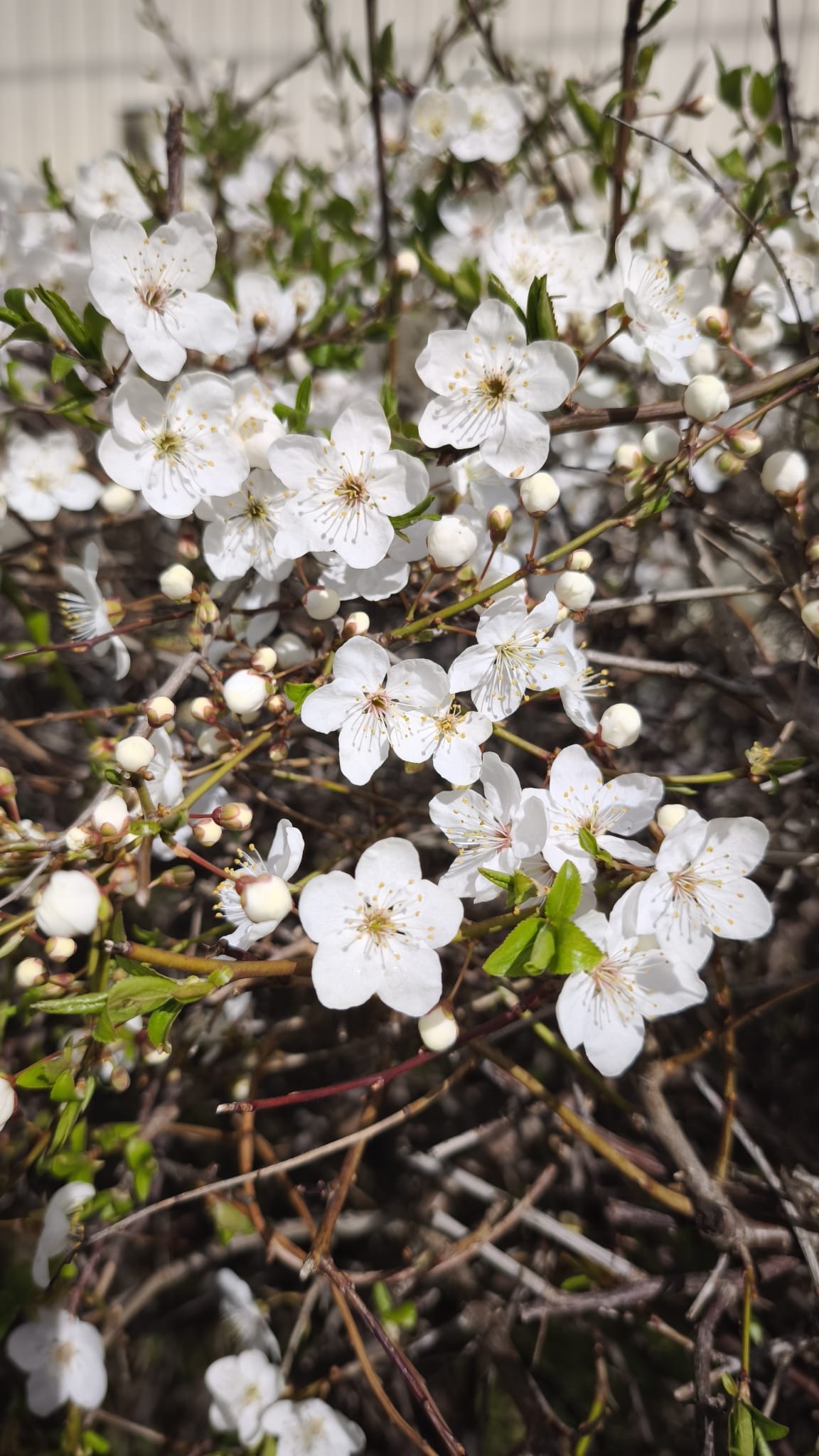
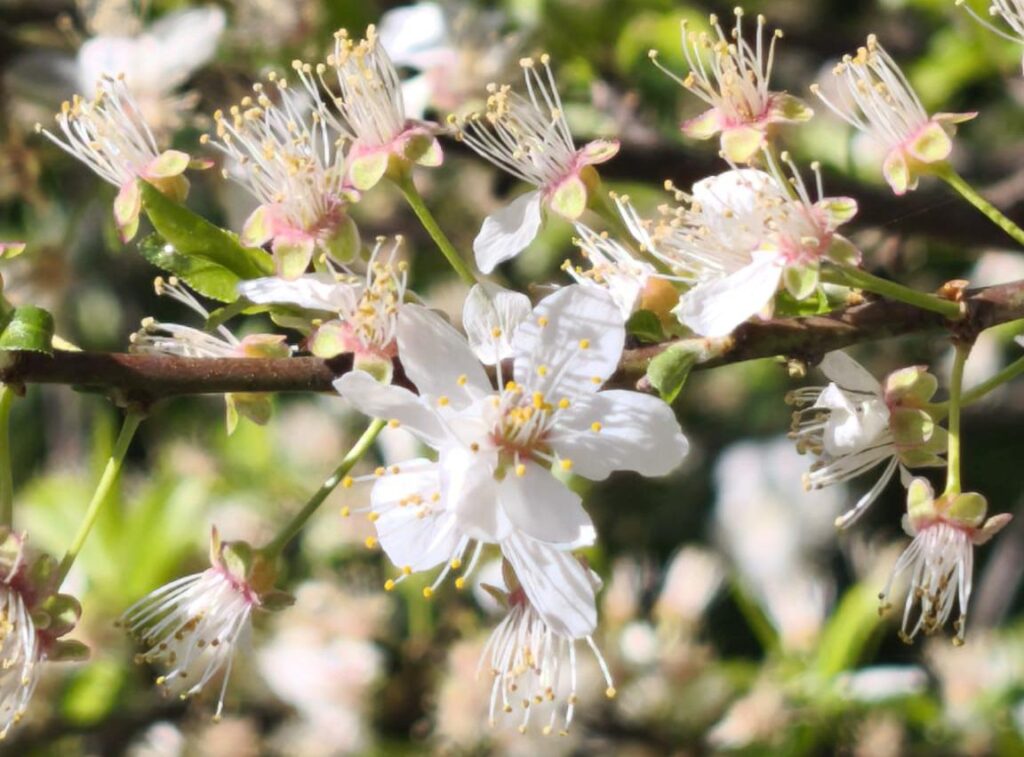
Poetry Month 2026 has just come to an end. As I am writing this post, it is the first of May – the first day after the end of Poetry Month. I am sitting by the window of the train, overlooking a vibrant blue sky and green trees passing quickly in front of my eyes. The world has become more saturated. Warmer. More visible. Sunny. This weekend, there will be 30 degrees. But I still remember that gentle time when I was walking through these honey-smelling paths, in a warm coat, a scarf painted with lilies, with eyes filled with awe and sometimes moved to tears, staring at these temporary, almost surreal white trees that felt like the symbol of the beauty in life. And that’s how I perceive poetry. A space for capturing beautiful fleeting moments. Engaging all the senses. Delicate by touch. Smelling of honey. Poetry is white trees.
On Instagram, I tend to celebrate this month by posting one poem every Monday, inviting readers to analyse its poetic devices and engage in discussion about poetry and the poem itself. I called this little tradition #MondayPoem.
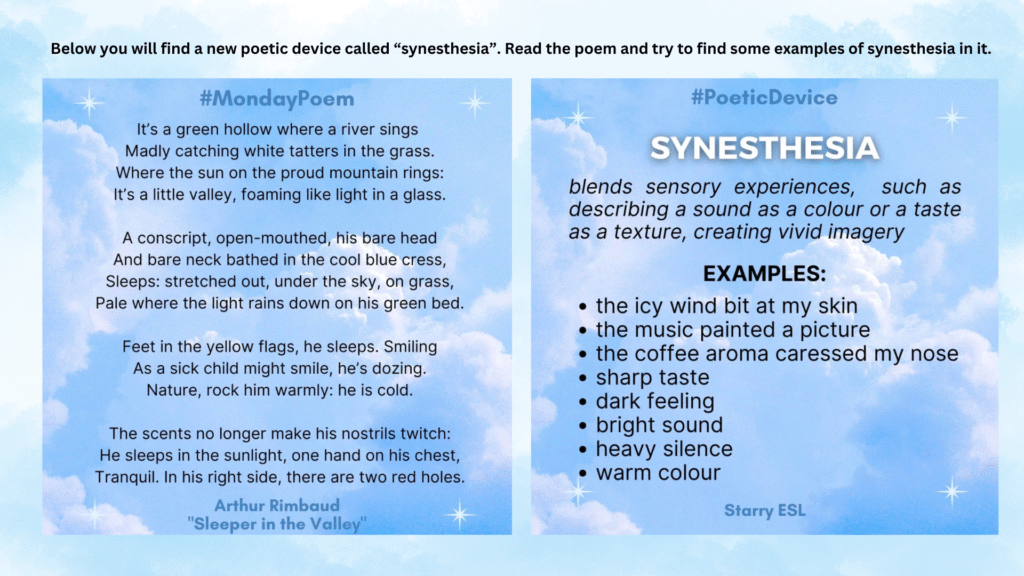
The first #MondayPoem post as part of our lesson.
This year, I’ve also conducted a few lessons about Poetry Month. They were all a little bit different. Individual and in group settings. Live and online. Private and in a public high school. Students’ responses to the topic varied a lot. Some seemed to appreciate it a lot. For others, it wasn’t their cup of tea. But still, I think it was meaningful – because it invited them to see the world through different lenses for the course of the lesson.
We talked about the origins of Poetry Month, street poetry, haiku (and wrote our own!), poetic devices and remarkable poems that we analysed together. I also shared some of my #MondayPoem posts with them and let them find the hidden poetic devices.
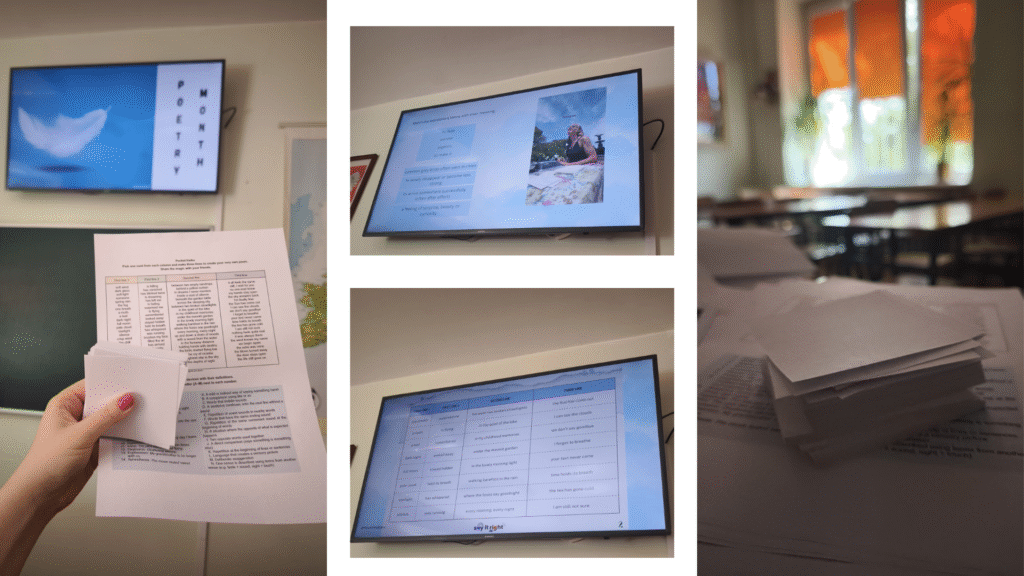
From my live lessons about poetry.
So, why is it a good idea to talk about poetry in the English classroom?
#1 CULTURAL VALUE
Teachers are intercultural mediators. The aim of a language teacher is not only to teach their language but also to build intercultural bridges. In order to step on such a bridge, one should be well acquainted both with their own cultural heritage and with that of other cultures. What better space for that than reading poems written both by poets of our native language and by artists coming from different countries? Students may discover some intercultural differences in writing style, freedom of expression and outlook on life. And then, even more importantly, they may realise that the most prominent themes, such as love, grief or self-discovery, are universal and beyond national identity – and this may perhaps bring them closer to people from all around the world.
This year, we discovered various poets, from Andrea Gibson to Arthur Rimbaud, discussed what haiku is, what poetic devices stand for and where Poetry Month comes from, using English as a tool for deepening our cultural knowledge.
#2 EXPRESSING OPINION
A lesson about poetry is a perfect space for training self-expression. Students may debate the value of poetry, form their opinion on the concept of street poetry or choose which Poetry Month celebration seems most appealing to them. Then, they may use a wide range of descriptive expressions to interpret poems, describing their atmosphere, imagery, symbolism and hidden meaning. Rings a bell? All of them are crucial skills required to, for instance, compare pictures during the CAE speaking exam. Finally, students will discover that their opinions vary. Some will perceive certain poems as positive while others as negative – and here is where the magic begins: let’s let them explain their interpretations, and perhaps even try to convince each other.
#3 NO WRONG ANSWERS
Apart from defining poetic devices, correct answers do not really exist in a poetry lesson. And here comes the surprise: students may discover that learning isn’t only about getting it right but also about nurturing curiosity and looking for their own ways to approach a task. Here, the journey replaces the goal. The aim is not to solve an equation but to stay present in the world of poetry, soak it up and make it your own.
#4 EMOTIONAL CONNECTION
There was a moment during one lesson when it all went quiet. After having written their poems accompanied by classical music, some students found the courage to share their poems with us. They were beautiful. Out of the blue, topics that normally don’t emerge during casual lessons appeared. What still hurts us? What is our purpose? What does my life actually look like? Am I happy? This moment of looking into oneself created space for identity-building and emotional connection with the language, which are what make learning most memorable. Unlike other school subjects, languages require something else besides passion or a good memory. They also require feeling good in that language and feeling as if you were your true self in it. And here, students could bring out something new and true about themselves in English, building their identity in that language, helping them feel like a foreign language is not a barrier to self-expression but a tool that helps them build it.
#5 BUILDING RAPPORT
Letting our students be vulnerable. Talking about our own vulnerabilities. Discussing our interpretations. Sharing the same perspective, or not. And then, telling each other what we meant. Helping our students redirect their focus from achievement to reflection. Giving space for sharing thoughts, no matter what they are. Letting students create something and then listening actively to what they wrote. Telling the entire group to listen. Appreciating each other. Putting effort into understanding what we meant. Finally, getting to know each other. A little bit more. A little bit differently. That’s how rapport is built.
#6 A PERFECT LESSON PLAN
From the point of view of a teacher majoring in teaching techniques, I’ll tell you that this topic is just perfect for someone who wants to build a comprehensive lesson plan.
Start with a hook: a picture representing poetry, a short poem, the theme of Poetry Month. Let the students guess the topic. Draw their attention. Focus their attention with a debate on the value of poetry.
Share some authentic materials: videos with street poetry or short haikus. They will both be of perfect length. Concise, filled with content, vocabulary-dense and standing on their own. Discuss some vocabulary from the given poems. Find some poetic devices in them. Count stanzas. Analyse the mood. Find themes. One can do a lot with poetic materials.
Then, let’s move on to semi-controlled and free speaking practice. Start by giving some sentence starters and lexical items, such as: “The poem conveys…” or “The atmosphere is… unsettling/ serene”. Students might elaborate on their own.
Finally, writing! Students are provided with prompts and write their own poems. Then, they share and discuss them. They become fully independent both as learners and… well, as poets!
There is space for group work (debates, brainstorming), pair work (exchanging interpretations), individual work (writing a poem) and sharing their work, followed by a final reflection with key takeaways from the lesson. I don’t know about you, but to me it feels quite satisfying!
#7 LEAVING THE CLASSROOM WITH SOMETHING YOURS
When it happens, the lesson feels complete to me. I really love it when my lessons leave a trace. Stay with my students. Equip them with some keepsakes. These keepsakes are physical proof that something new was built. Sometimes, it is a Christmas card written for your classmate in another language. Another time, it is a poster about the environment that you presented during our lesson. Or just like here, it is a poem written on a little piece of paper.
This time, I was inspired by one of the official celebrations of Poetry Month called “Pocket Poetry”. The idea is simple. You write down or print out a tiny little poem and put it in your pocket. Then, you carry it around, showing it to some people around you throughout the day.
When our lesson ended, I asked my students to fold their pieces of paper, put them in their pockets and then share them with someone, whether it was a friend or a family member.
#8 DEBUNKING MYTHS ABOUT POETRY
Poetry can make part of our lives. It’s not just a distant idea we learn about in textbooks. Everyone can write poems. Everyone can interpret poems. We can surround ourselves with poems. We can make them a topic of discussion. Poems can bring us closer to our friends. And to ourselves.
So, that’s how it all could be. A poetry lesson filled with meaning. One that stays for longer.
And what if it doesn’t work?
There is always that option. And that’s okay. Actually, there are quite many things that may go wrong:
- Students may not enjoy poetry itself and thus may be reluctant to engage with the topic
- Some students might find it hard to look into themselves or talk about deeper topics out loud
- Interpreting poems might actually take much longer than we expect. When it happens, let’s invite it. Quality over quantity. Perhaps our lesson plan will not be fully fulfilled, but it might open some doors for our students to find their own voice – let’s listen to it and cherish that moment.
Learning English through poetry might surprise. In all different ways. Reactions will vary. But that’s excellent. Cause emotion is what makes learning most effective. And unforgettable.
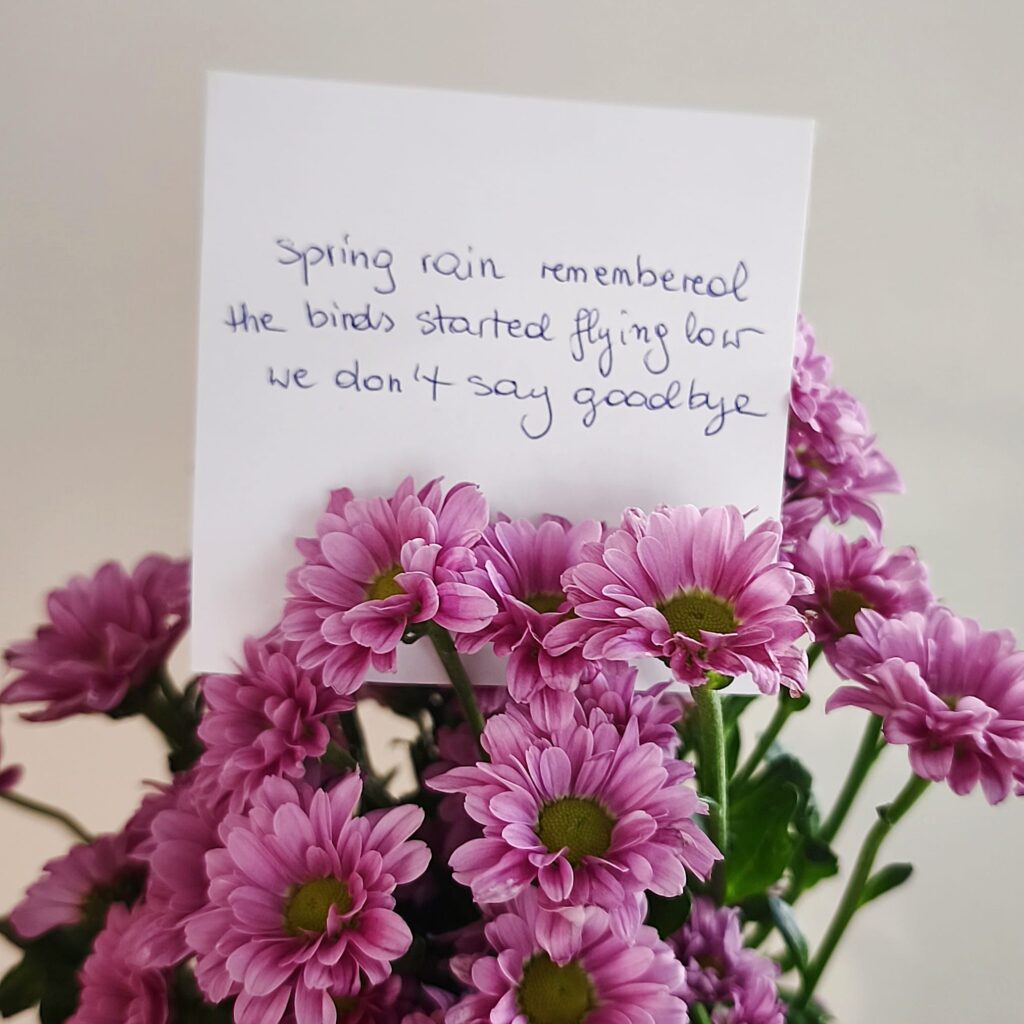
The very first haiku I wrote using the prompts created by @mluvimnabaru.
Have you ever discussed poetry during your English lessons? Would you like to?